
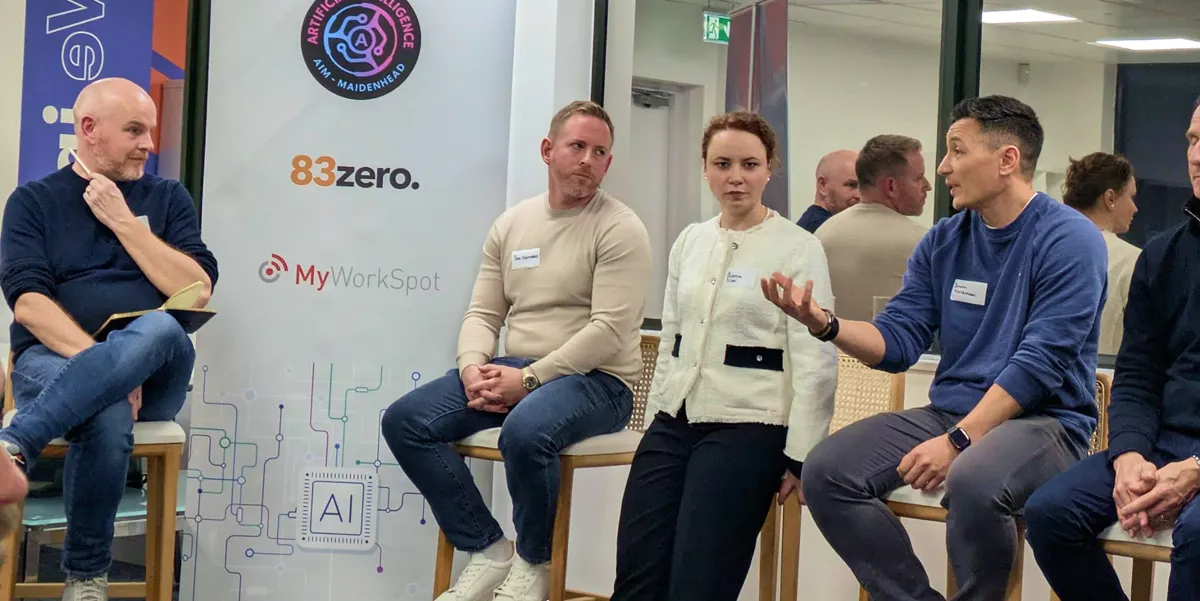
A couple of weeks ago I sat on a panel at AI in Maidenhead alongside three Product Managers, Ben Saunders, Steve Braden and Iustina Ilisei, to talk about what AI is doing to our roles.
I was the UX and product design voice in the room. And the most useful thing I brought to the conversation, I think, was being willing to say: I genuinely don’t know what comes next.
The honest answer
There’s a version of this kind of panel where everyone arrives with a polished take. A confident prediction. A clean narrative about where things are heading.
I didn’t have one. I still don’t.
What I do know, from twenty years working with digital products, is that experience design isn’t going anywhere. People still need to understand what they’re looking at. They still need to feel oriented, safe to continue, clear on what happens next. That part hasn’t changed.
But the shape of the work? That’s shifting fast.
The blurring is real
Two years ago, most teams were using AI to answer questions. Now it’s being used to build full products and the pace of that change isn’t slowing.
And what’s happening at the edges of our roles reflects that. The line between UX designer, product manager, and engineer is getting harder to see. The decisions that used to belong clearly to one discipline are now being made by whoever’s closest to the problem, which is sometimes a different person every sprint.
That’s uncomfortable if you’ve built your identity around a job title, but it’s interesting if you haven’t.
The people doing the most compelling work right now seem to be the ones leaning into the blurring rather than defending against it. Not abandoning craft, but holding it more loosely.
What the room kept coming back to
Two things surfaced repeatedly in the panel and in the audience questions: critical thinking and the human cost.
Not the tools. Not the models. Not which AI stack to use.
The harder, slower, more human skills. The ability to question outputs. To ask who gets left out. To slow down when speed is making things worse.
That felt important to name. Because the conversation around AI in product is often dominated by what’s technically possible. The more urgent question, as far as I can tell, is what we choose to do with it — and what values we bring to those choices.
Why being in a room still matters
There’s something quietly significant about the format of AIM itself. A few hours with no slides, no demos, no livestream, just people thinking out loud together.
The irony isn’t lost on me: one of the most useful conversations I’ve had about AI happened somewhere that was, for a few hours, almost entirely free of it.
Thanks to Chris Jackson, David Eales and everyone who came. The community you’re building feels like exactly the kind of thing the industry needs more of.
I left with my thinking properly challenged, which, honestly, is the best outcome I could have hoped for.